
Why Websites Get Slower Without Anyone Noticing
Learn why website performance gradually declines over time, how hidden issues impact SEO and conversions, and why website performance monitoring matters more than a one-time website speed test. Modern websites rarely become slow because of a single mistake. When companies notice declining rankings, lower conversion rates, or worsening Core Web Vitals, they often look for a recent release, a broken deployment, or some major technical failure. In reality, that is rarely what happened. Most websites get slower gradually. The decline happens so slowly that nobody notices it until the impact starts showing up in SEO performance, customer experience, and revenue. The problem is not usually one bad decision. It is the accumulation of dozens of small changes that seem harmless on their own.
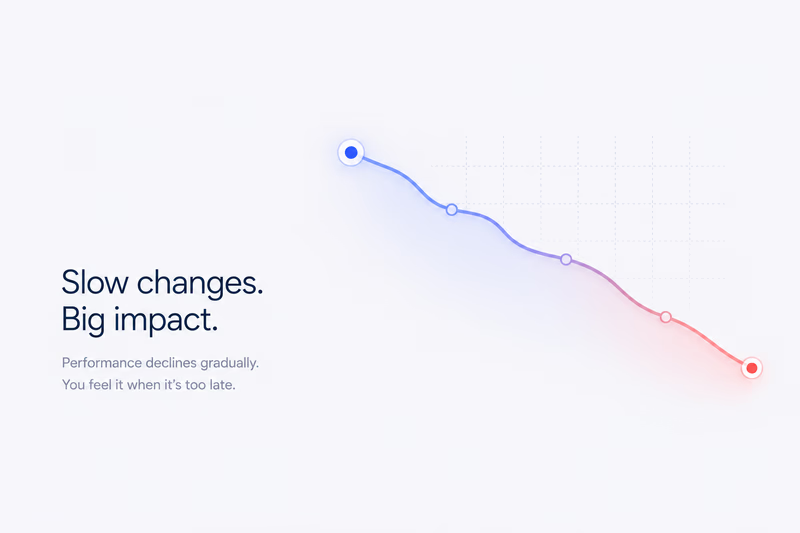
Most websites don’t get slow because of one mistake. They get slow through accumulation: a pixel here, a widget there, a few A/B tests, each reasonable on its own. Each addition is a little more performance debt, and the decline is so gradual nobody notices until it shows up in Core Web Vitals, conversions, and revenue, with the original cause buried under months of changes. Here’s how that happens and how to catch it.
For the complete framework, see our Core Web Vitals monitoring guide.
The slow growth of technical weight
Imagine an ecommerce site that launched six months ago. The team ran a website speed test before launch. Scores looked good, pages loaded quickly, Core Web Vitals were healthy, and everyone moved on.
Then the business started growing. Marketing added new tracking pixels. A chat widget went in to improve support. Product teams launched recommendation modules. Analytics tools expanded. A new review platform was integrated. Several A/B tests were added to key landing pages. Each change made perfect business sense, and none looked dangerous during implementation. But every new script, integration, and third-party service added a little more weight. The result is what many teams never see coming: the site that scored 95 at launch behaves like a completely different platform six months later.
Why website performance problems stay invisible
One reason performance issues go unnoticed is that most teams only check performance occasionally. A website performance test gives a snapshot of how a page performs at a specific moment. That snapshot can be useful, but it doesn’t tell you what happens next week, next month, or after the next ten deployments.
A homepage may still look healthy during an audit while product pages quietly get slower. Mobile users may hit degraded performance long before desktop users notice anything. Certain templates may be affected while others stay stable. Without ongoing website performance monitoring, these changes can stay invisible for a surprisingly long time, especially on large ecommerce websites where hundreds or thousands of pages are constantly changing.
Why performance decline hurts SEO
Google doesn’t evaluate your website based on how it performed six months ago. It evaluates how it performs today. As sites get heavier, loading times rise, responsiveness drops, and user experience suffers, which eventually affects Core Web Vitals, crawl efficiency, engagement, and search visibility.
The frustrating part is that rankings often decline long after the original cause was introduced. A script added three months ago may contribute to slower rendering today. A frontend change that seemed insignificant during development may gradually affect dozens of templates. By the time teams investigate, pinning down the original source is hard, because so many changes have happened since.
The difference between audits and monitoring
Many companies still rely on periodic audits for performance reviews. Audits are valuable: they help identify opportunities for page speed optimization and reveal technical issues worth attention. The limitation is that an audit only shows what exists at the moment it runs.
Web performance monitoring serves a different purpose. Instead of one moment, it tracks how a site evolves over time, helping teams see when performance started changing, which pages were affected, and whether recent releases introduced regressions. Put simply: a website speed test tells you where you are today; website performance monitoring tells you whether you’re moving in the right direction. For growing ecommerce businesses, that distinction matters more and more.
Why large websites are most at risk
The larger the website, the harder performance is to manage by hand. A marketing site with twenty pages can be reviewed without much effort. An ecommerce platform with thousands of product pages is a completely different challenge. Different templates evolve independently. Different teams contribute changes. Third-party integrations behave differently across page types. Mobile performance may differ significantly from desktop.
This is why many SEO teams and agencies now monitor thousands of URLs instead of relying on a handful of representative pages. The biggest performance problems rarely start on the homepage. They usually appear deeper in the site, where nobody is looking.
Website speed optimization is not a one-time project
One of the biggest misconceptions in SEO is that website speed optimization has a finish line. A team completes an optimization project, improves scores, closes the ticket, and considers it done. In reality, modern websites are living systems. They continuously evolve through new releases, content updates, integrations, experiments, and business requirements, so performance needs ongoing attention. The companies that keep strong performance over time aren’t necessarily the ones with the fastest sites today. They’re the ones that detect changes early and stop small problems from becoming larger ones.
What gradual decay means for your site
Most websites don’t become slow overnight. They get slower gradually, through hundreds of small decisions that make sense individually but collectively change how the site performs. That’s why a single website performance test is rarely enough. Understanding long-term trends takes continuous visibility into how pages behave after releases, integrations, and content changes. For modern ecommerce businesses, website performance monitoring is no longer just a technical exercise. It’s an important part of protecting SEO, customer experience, and revenue over time.