
How SEO Teams Monitor Core Web Vitals Across Thousands of Pages
Most companies believe their website performance is under control until they run a large-scale audit and discover hundreds of slow, degraded pages hidden deep inside the site. Modern SEO is no longer just about optimization, it is about continuously monitoring performance across thousands of URLs before rankings and conversions start to suffer.
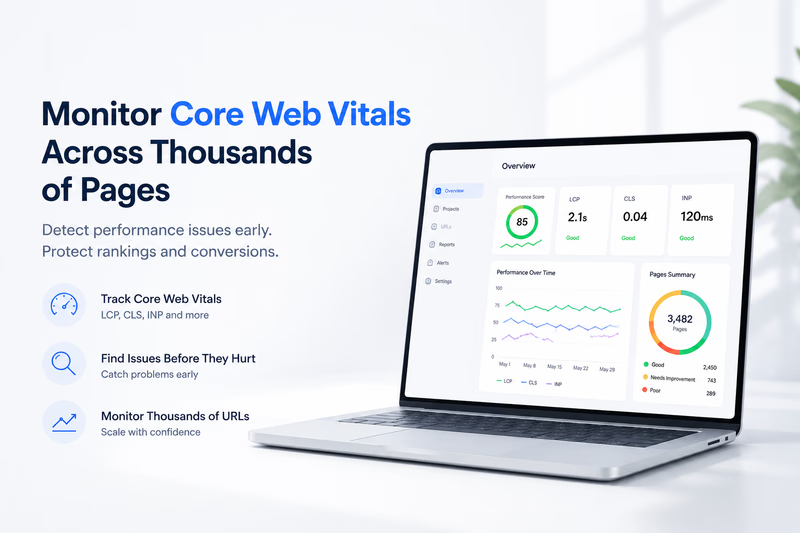
SEO teams monitor Core Web Vitals across thousands of pages by automating what used to be manual: recurring Lighthouse and PageSpeed audits, historical tracking, and regression detection that runs across every page type instead of a handful of URLs. The reason is simple. On a large site, homepage performance tells you almost nothing, and slow pages hide deep in the structure for weeks before anyone notices.
Most companies believe their performance is under control. The homepage loads fast, Lighthouse scores look decent, and PageSpeed Insights is mostly green. Someone checked a few important pages before launch, everything seemed fine, and the topic dropped off the priority list.
Then a full-scale audit begins, and the picture changes completely. Product pages score below 60. Filtered category pages fail Core Web Vitals. Mobile performance drops after a new marketing script. Whole sections slow down after releases while nobody inside the company notices for weeks. This is one of the biggest hidden problems in modern technical SEO, and it isn’t really about optimization. It is about visibility. Most teams simply don’t monitor performance at scale.
This is one piece of our Core Web Vitals monitoring guide.
Why manual Lighthouse audits no longer work
Plenty of SEO teams still rely on manual Lighthouse checks: open a page, run an audit, read the score, move on. That stops working once a site grows past a few dozen URLs. Large ecommerce sites, marketplaces, enterprise platforms, multilingual projects, and anything with faceted navigation can generate thousands of unique page states, and each one can behave differently.
The dangerous part is that regressions rarely happen all at once. The decline is usually slow. A new Shopify plugin gets installed. An analytics platform injects extra JavaScript. A marketing tool adds tracking scripts. An A/B testing system increases rendering time. Individually these look harmless, but together they create technical degradation across hundreds or thousands of pages. By the time rankings or conversions start dropping, the problem has already existed for weeks or months.
Why homepage performance means almost nothing
One of the most common misconceptions in SEO is that homepage performance reflects the whole website. On large sites, performance profiles vary widely by page type. A homepage may score 95 in Lighthouse while product pages sit around 70 and dynamically filtered category pages collapse below 45.
Many teams never spot these gaps because nobody checks deep enough. Modern sites constantly generate new page combinations through filters, pagination, localization, search results, campaign URLs, dynamic rendering, and parameter-based navigation, and every variation can affect Core Web Vitals differently. That is exactly why scalable monitoring has become essential technical SEO infrastructure.
Core Web Vitals are becoming operational metrics
Google has spent years pushing LCP, CLS, and INP, yet many businesses still treat them as optional optimization tasks instead of operational metrics. In practice they directly influence user experience, mobile usability, crawl efficiency, conversion rates, and long-term ranking stability.
The catch is that degradation is gradual. Nobody panics when LCP rises half a second, and nobody notices JavaScript payloads getting heavier after every deployment. Six months later the whole site feels slower. This silent decay is common in large ecommerce environments, where releases happen continuously and third-party integrations keep evolving.
Why continuous monitoring matters
Running Lighthouse by hand across a large website is unrealistic. Modern SEO teams increasingly need automated monitoring, historical tracking, recurring audits, regression detection, and visibility across thousands of URLs at once. Without automation, companies work reactively: they find issues only after rankings decline, traffic drops, or conversions suffer, by which point the damage is already hitting revenue.
Website performance is no longer just a developer concern. It affects visibility, search performance, and business growth, and every release introduces risk through plugins, scripts, frontend changes, analytics tools, rendering updates, and external integrations. That is why more teams are moving toward continuous website performance monitoring instead of occasional audits. Modern websites are never static, and performance is never permanently “fixed.”
What this means for large sites
The larger a website gets, the harder performance is to manage by hand. Most companies don’t lose rankings to one catastrophic mistake. They lose them gradually, through invisible degradation spread across hundreds or thousands of pages. That is why scalable Core Web Vitals monitoring matters so much: somewhere deep inside a large site, something is probably already slowing down. The only question is whether your team notices it before Google does.